Welcome to The Blog!

Thursday, April 5, 2012

Competitions for Writers

123freevectors.com
One of the most important things when writing query letters to agents or publishers is listing your credentials. Most publishers and agents these days want to know where in the writing industry you’ve previously been published, or if you’ve won awards, etc. It’s always better to start small and work your way up in the industry, and what better way to do so than to enter your work into some contests? Contests often award certificates/ribbons for the top 3 pieces of writing, cash prizes, and even publication! They’re a quick way to build up some credentials to add to those query letters and let agents and publishers know that you’ve broken out in the business—even if it’s small at first.


Before you enter contests, however, there are a few things that you should be aware of. The first is the legitimacy of contests. There are many fraud sites out there trying to get writers to enter their contests. What do I mean by fraud? It could be one of many things, including theft of work. However, the most common is a contest which everyone who enters is published, and the hosts of the contest require the “winners” to purchase a copy of the book their work is published in. If you win a contest, you receive a free copy—always remember that! The second thing to be aware of with contests is entry fees. Not every contest requires a fee to enter, but many of them do (especially ones that offer cash prizes to winners). Another thing to remember is that most times, contests only accept works that are previously unpublished. Many times, just like regular publishers, as well, contests which publish work retain rights to your work for a certain amount of time. This means that they are given the rights to first time publication and many times, you need their written permission before getting that work published elsewhere. However, not all contests do this—some give full rights back to the writer so that they can publish their work elsewhere if they wish. Just make certain that before you enter contests, you read all of their rules and regulations and agreement statements before submitting your work.


Now, here is a list of only a few of the many upcoming contests for the 2012 year:
  •  Writers’ Digest Self-Published Book Awards
    • Perfect for those of you who have been daring enough to self-publish a book. This would be a quick way to get your book recognition, money, sales, and even perhaps an actual publisher! It is the 20th year that the Writers’ Digest has been holding this contest, and there have been many wonderful winners in the past. There is one grand-prize winner for this contest, nine first place winners, and honorable mention winners! There are also different categories in which you can enter your book. The grand-prize winner not only receives the recognition I mention above, but also $3,000 and a trip to the Writers’ Digest Conference in NYC! Deadline is April 20th, 2012
  • Writers’ Digest 81st Annual Writing Competition
    • A chance to enter some polished pieces you have that you’ve just been waiting to get exposure on! With 10 different categories to enter, you can choose which best suits your niche. Just like their self-published book contest, the grand-prize winner receives $3,000 and a trip to the Writers’ Digest Conference in NYC! However, they also receive critique/attention from four different editors and agents! Deadline is May 1st, 2012
  • EVVY Awards
    • Held by our very own Emerson, here’s a chance to get some exposure for your work and an award that certainly will shine on your resume and credentials. While we all know that the EVVYs are definitely one of the highlights of the year, what’s better than actually having your work eligible to receive one—in front of a live audience? Not only will you be receiving an award that will push your credentials and resume, but it also gives you a chance to be an EmCeleb! Deadline is April 6th, 2012
    • For more information on this contest, please visit: http://evvyawards.org/evvys/submit/
  • For a list of a bunch of other wonderful contests, you can also check out this site. It lists the deadlines and prizes for them, as well as linking to the sites providing guidelines. These are more for the actual literary awards, so the competition is tougher, but the reward in the end is far greater—especially in your credentials: http://www.be-a-better-writer.com/creative-writing-contests.html
And, remember! Every year, the Writers’ Market always comes out with new books for poetry and short stories where you can find hundreds of contests. All of them are legitimate, so you don’t have to worry about fraud! Be sure to pick up a copy, or look for one at the local library. They usually always have a copy in, so you can browse multiple contests and get your work out there.
Good luck in your contest ventures, and keep that credential list building!


Written by Erin Sinnott

Spring Book Releases


www.ew.com
Sisterhood Everlasting by Ann Brashares 
Looking for some fresh reading material or ready to start shelving some books in preparation for those long summer days? As if there weren’t already enough titles on my to-read list, here are some of what look to be the best new releases in the coming months. For anyone who loved the Sisterhood of the Traveling Pants, all four girls are back, this time grown up and without their treasured jeans. Get ready for some teenage nostalgia and reflections on growing up.
Paperback release: March 6 (Hardcover version released June 14, 2011)
Publisher: Random House
ISBN: 978-0-385-52123-9


goodreads.com
The Might Have Been by Joseph M. Schuster
A minor league baseball player loses his chance to play for the major leagues, and must live with his regrets until he has the chance to give two young players the opportunities he never had. For sports lovers and those looking for what is sure to be a heart-warming tale.
Release: March 20
Publisher: Random House
ISBN: 978-0-345-53026-4


litlove.files.wordpress.com
Waiting for Sunrise by William Boyd
A suspenseful page-turner set in early twentieth century Europe. Lysander Rief’s life begins falling apart amid many mysterious events. If you’re looking for a thrilling beach read with just a little more substance than the norm, plus an awesome setting, this is worth checking out.
Release: April 17
Publisher: Harper Collins
ISBN: 978-0061876769


dearphotograph.com


Dear Photograph by Taylor Jones
A picture book, in all senses of the word. The book is based on the website dearphotograph.com where people write letters to old photos. Sometimes sad, and sometimes funny, and definitely worth a look through.
Release: May 8
Publisher: Harper Collins
ISBN: 978-0062131690


goodreads.com
The Other Side of Normal by Jordan Smoller
Ever wonder if what you do is actually normal? This book promises to get to the bottom of normal vs. abnormal human behavior. For anyone interested in psychology or the way the mind works, this looks to be a thought-provoking read.
Release: May 8
Publisher: Harper Collins
ISBN: 978-0061492198


goodreads.com
Second Chance Summer by Morgan Matson
A young-adult novel about Taylor Edwards who goes back to her childhood vacation home with her dying father and the rest of her family and finds out that while some things have changed, some haven’t.
Release: May 8
Publisher: Simon and Schuster
ISBN: 978-1416990673


booksmith.com
I Suck at Girls by Justin Halpern
A collection of essays by the author of Sh*t My Dad Says. If this is anything like his hilarious and not-at-all-politically-correct tweets, this is a must read.
Release: May 15
Publisher: Harper Collins
ISBN: 978-0062113375


Sources:
http://www.harpercollins.com/Book/Upcoming_Books.aspx
http://comingsoon.simonandschuster.com/
http://www.randomhouse.com/


Written by Miriam Avila

Book Review: The Call by Yannick Murphy


www.tower.com
I spent about an hour scouring the “newly released” section/shelf of my local library for anything with a synopsis that didn’t read like a Lifetime movie. Yannick Murphy’s third novel, The Call, not only fulfilled this requirement, but also enticed me with its cleanly designed cover (not exactly a great judge of a book’s quality, but I was desperate, having forgotten to leave enough space in my suitcase for winter break reading materials) and copyright page boasting an excerpt’s appearance in McSweeney’s #29 [Murphy’s work is also featured in the current issue of McSweeney’s Quarterly Concern, #39—a coincidence which I find amusing mainly because I am bored].

Of course, The Call is good: I wasn’t going to force myself to read something unsatisfying or dull during my short break from psychology textbooks and literary theory. And it’s good despite the fact that it’s about a veterinarian, taking calls to heal horses and cattle in a small, mountainside town.

Wait, that description enticed you? Is the last book you read Misty of Chincoteague? Or was it maybe something from the Animal Ark series? I mean, that’s fine, but then you shouldn’t read this book.

The Call is a novel about more than the immature themes of “family, community, [and] the human bond with animals,” which Pulitzer Prize-winning author Geraldine Brooks applauds Murphy for tackling. Although we’d all love a book about animal activism because, hey, bunnies have feelings too, this one wasn’t written by Jonathan Safran Foer. If you look closely enough (I’m talking eighth-grade-analysis level), it’s about human interdependence. It’s about the decay of American subsistence farming and waning attitudes of self-sufficiency in a country proud of its DIY fetish and rebellious heritage. It’s about aging and losing and slipping away.


We watch David, the protagonist whose name really is unimportant, forgettable, fail to save the animals he’s paid to treat. But instead of focusing on the image of a stillborn calf’s carcass being torn in half as David tries to pull it from its pained mother’s uterus, an image Murphy relays with a disturbingly clinical affect, we are struck by the character’s reaction (or lack thereof) to the blatant display of annihilated innocence: “THOUGHTS ON DRIVE HOME WHILE PASSING RED AND GOLD LEAVES ON MAPLE TREES: Is there a nicer place to live?”

This is a book of reactions; most of the time, conversations—about a comatose son, a sperm donation, a crime unsolved—aren’t even dictated to us. Murphy, instead, presents us with a slew of David’s silent regrets and desires, and, from them, we feel him straining against piles of problems unresolved.

Composed of thoughts categorized and labeled by their subject, The Call is a novel that pushes the notion of a first-person perspective to the extreme. Consider the “meta” trend that is enhancing/destroying contemporary art: The Call embraces the fad, going so far as to announce David’s unreliability as a narrator each time he offers up snippets of dialogue by explaining that these are words filtered by the ears of a distressed/crazed/vengeful/homicidal mountain man. It seems that even mainstream authors (because someone published in McSweeney’s can hardly be considered “underground”) are experimenting with post-modern techniques in addition to shrouding their work in dramatic post-modern attitudes.

Does The Call prove that hipster isn’t hipster anymore? Maybe. That is a topic for discussion in an essay to be written for an Emerson literature course.

But if you are suffering from an existential crisis and would be pleased with the ability of a contemporary author to capture crushing despair in a book structured like a medical log, you should stop reading when the section entitled “Still Winter” comes to a close. What follows is the emergence of an unforeseen springtime cure, which sprinkles its magical fairy dust along the creases in David’s crumpled life. Oh, spring and it’s stifling aura of rebirth.

The change in season renders the world a calming place where the character’s tense muscles are kneaded into a sugary cake iced with vanilla familial love.  Maybe the intrusion of positivity in Murphy’s exhaustingly depressing novel is merely an indicator of her optimism for the human condition. But David’s decline is preferred to any neat-and-tidy ending fraught with clichĂ©s and excess sap.

I guess I failed to avoid the Lifetime novel, after all.


Written by Ellen Duffer

Thursday, March 8, 2012

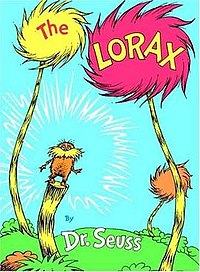
The Lorax: Book & Movie

I think The Lorax is a cool book.
The movie might be worth a look.
The Lorax is also its name;
It’s different but still the same.


en.wikipedia.org

The Lorax, which opened in theaters March 2nd, is the tale of a world destroyed by consumerist greed. Based on Dr. Seuss’ book of the same name, the movie goes into more detail than the short book ever could. Seuss’ world is expanded onscreen as the movie builds off the colorful illustrations in his book for its aesthetics. For example, the unnamed city of the book is given life and dubbed Thneedville. It is portrayed as a colorful plastic place where the “trees” are inflatable, light up, and work as disco balls too. The imagined city, based off the buildings on the first page of the book, fits with Seuss’ whimsical illustrations even though it was never explicitly described. However, the Lorax, Humming-Fish, and bearlike Bar-ba-loots all look like they jumped right off the page. The beautiful Truffula Valley appears almost exactly how Seuss portrays it in his book. While the movie’s animation imitates the book’s pictures fairly well, the plot is expanded and altered in order to extend the story into a feature film.

www.joblo.com

One of the main ways the book was adapted was to add in subplots and develop the characters. For example, Dr. Seuss addresses the reader in his book, but the movie has an actual character. The boy in the red-striped ensemble from Seuss’ illustrations becomes young protagonist Ted. Other additions to the story include love-interest Audrey, bad guy O’Hare, and Ted’s crazy mom and grandmother. The Once-ler’s family, while only making a brief appearance in the book, becomes individualized and developed – we’re treated to a greedy aunt, uncle, and cousins along with a doubting mother. The Once-ler gets a detailed backstory, which explains his motivations for making Thneeds. The tale of how he destroyed all the trees is embellished and features the Lorax’s attempts to get rid of him, along with their burgeoning friendship. This relationship is not explored in the book at all. In another deviation, the Once-ler gives the Lorax his word that he will not to chop down any more trees. But of course he breaks his promise.


According to the production notes from the official movie website, the movie team tried “to flesh out the book’s characters and create a complementary world” in order to “craft a feature production that would draw audiences further into its story” by filling in “what happened before the book began and after it ended.” This technique of fleshing out characters and building off of the given plot is generally used to make short books into longer movies. The Lorax, following the great tradition of books into movies, maintains Dr. Seuss’ whimsical vibe while expanding upon his classic story.


Written by Alex Kowel

Book Review: Divergent by Veronica Roth

“I stare into my own eyes for a moment. Today is the day of the aptitude test that will show me which of the five factions I belong in. And tomorrow, at the Choosing Ceremony, I will decide on a faction; I will decide the rest of my life; I will decide to stay with my family or abandon them.


For anyone who is an avid fan of The Hunger Games trilogy or just loves a good helping of action-packed dystopia, Veronica Roth’s debut book Divergent definitely earns it place as one of the freshest young adult dystopian novels on the bookshelves.

Set in the futuristic urban environment of Chicago, our heroine, Beatrice “Tris” Prior, lives in a society divided and ruled by five personality-based factions: Dauntless (the brave), Amity (the kind), Erudite (the intelligent), Candor (the honest), and Abnegation (the selfless). Although separated, these factions work peacefully together in a checks-and-balances fashion that allows everyone to live harmoniously without the consequences of warfare or corruption. The story begins on the day of Tris’s aptitude test, an examination that all sixteen-year-olds of the society are required to take that recommends which faction best suits their character. Because her parents are from Abnegation, Tris has endured a strictly basic lifestyle with her family, a selfless and simple life that has left her feeling more like an outsider than a member of society. Upon this realization comes the allure of the Dauntless, the notoriously dangerous and dare-devilish faction that Tris feels drawn to despite her modest upbringing.

www.divergentthemovie.net

Ultimately, Tris grapples with her identity and her independence, the choice to stay with her family or to embark on a different path, and the novel traces the shocking reveal of her tests results to the faction she inevitably chooses in the end. Does she choose the faction that she feels safe and familiar with, or the one that can help reinvent her into the person she feels she was meant to be?

Seriously, for anyone who loves dystopia, an action-packed story, or a heroine who isn’t annoying, this book is definitely for you. Dystopia has sky-rocketed to one of the hottest genres in young adult literature, and this book is a clear example of why. For starters, Roth sets the reader in a very grounded environment and society, one that is so creatively and eerily systematic that something is bound to go wrong. This situation gives the opportunity to tell the story of Tris, an unassuming, bullied Abnegation girl who starts to grow into herself through the decisions she makes and the shocking secrets she discovers about her seemingly perfect society. The story doesn't really begin until after she makes her choice of what faction she wanted to choose—but of course I couldn't reveal that little spoiler. 

The book then goes on to trace the initiation process of her chosen faction, where she encounters an interesting handful of characters, along with a mysterious and intense guy (a.k.a. the love interest), who help guide her and the plot line itself. One of the best things about this book is that although there is romance, it does not define the story’s momentum or slap you in the face every other page. While the romance factor is a definite pull for all the love-junkies out there, this book has a lot more to offer than dewy-eyed teenagers repeatedly mooning over each other. Roth has managed to ground real life teen problems within this unbelievable and futuristic setting, such as independence, identity and self-discovery, fear, bullying, parents’ expectations, separation, and more. Roth has even created a pretty strong heroine that people can actually appreciate, one who becomes stronger and tougher in dealing with these real life issues in her surreal world (no Bella Swans in here, I assure you). There is action and good, quick writing in this book, and there are also messages that hint at something in our own society like a precautionary tale. But then again, what did you expect from a dystopia? I promise you, pick this book up and it won’t disappoint.

Written by Janella Angeles

Humming & Strumming & Writing it Down

Goodreads.com
In which the novel Bright’s Passage by Josh Ritter and his Musical Stylings are Discussed

“Artillery passed high above their heads in singsong trajectories that merged and lifted with one another into strange musical chords, like cats crossing pump organs.” 
--Josh Ritter, Bright’s Passage p. 67

I’d call Josh Ritter a storyteller. I think he’d call himself a storyteller, too. He’s known and acclaimed for his singer-songwriter folk with a prosaic bent and, more recently, for his debut novel, Bright’s Passage. Josh has garnered much praise for his songwriting, considered by some to rank among the likes of Bob Dylan. His success lies in his storytelling abilities through music, his well-crafted lyrics, and the emotion in his songs. In one song, “The Temptation of Adam”, the narrator Adam , an operator for an underground missile operation tells the story of he and Marie, another operator, their love affair, and his fear for their love when they return to reality. Another, “The Curse”, tells the story of an Egyptian mummy, exhumed and brought to New York by an archaeologist with whom the mummy falls in love. But because he was taken from his tomb, the curse that he carries with him eventually kills the woman he loves. And then he has lines of poetry like these from “Southern Pacifica: “Climb through the timbers/ And I’ll breathe the dust/Of cosmos and wild rose bud/ And thunder the unknowns/ In the phosphorous white glow/ Of saber-tooth bones in the dusk.” Both his stories and his lyrics are compelling.


But then there’s the music itself. “Temptation of Adam” would never be as endearing as it is without the tremulous horns and quivering strings that are featured throughout. The main accompaniment in The Curse is a waltzing piano that, with its crescendos and diminuendos creates a dreamlike quality to the song. I’m not trying to discredit Ritter’s abilities as a lyricist or to say that his narratives are dependent upon the music that accompanies them to work. The music, rather, enhances the story; it speaks to something more primal in the listener and tells the story in ways that words can’t.  Literature has the same impact, but clearly achieves it differently. The words become much more important because they are all the storyteller has to go on. So, in considering Bright’s Passage before readingone of my biggest sources of skepticism was simply this: without the help of major or minor chords, lilting strings or finger-picked guitar, would his words have the same weight? And yes, despite his success as a songwriter, I was skeptical. Being good at one art form does not guarantee success in another.  

Curiously enough, Bright’s Passage began as a song. The story’s life as a song was short-lived; however, as after several attempts Ritter scrapped all attempts. But he found he had a lot to say about Henry Bright, more than could be said in a span of 3 or 4 minutes. So, Ritter sat down to write 1000 words a day for fifty days (his work ethic is enviable), and had himself a first draft. He spent 7 months editing the story into the novel in its present state. Bright’s Passage tells the story of WWI veteran Henry Bright and what befalls him when he heeds the demands of an angel. After Bright’s wife, Rachel, dies in childbirth, Bright burns his home at the urging of the angel (who speaks to him primarily through his horse) and flees with his son to escape the fire and Rachel’s father, the Colonel. It was at the angel’s urging that Henry stole Rachel away from her home to marry her, and the Colonel, along with his two dolt sons, pursue Bright and the baby to exact their revenge. Along Bright’s journey, his past both in West Virginia and in World War I are told through a series of flashbacks. Henry first came into contact with the angel during the War in a church in France, where the angel saved him and promised to make his son the Future King of Heaven. As Bright makes his journey and adjusts to having a baby, the threat of the fire and the Colonel’s revenge looms very close behind him.

The most important similarity between his music and his literature is that they focus on the same themes. War is a reoccurring theme; some of his song characters are soldiers or discuss war, as in “The Temptation of Adam” or “Girl in The War”. Religious allusions are frequent in his music. Male characters in pursuit of ideals are also recurrent; songs such as “Next to the Last Romantic” and “Another New World” feature such characters. And of course, love is nearly omnipresent. Also, many of the songs feature characters that possess some kind of folk history or Americana. Even an untrustworthy angel is featured in one of Ritter’s songs, “Galahad” (to be discussed at length shortly).

In an interview with PBS News Hour about Bright’s Passage, Josh commented about the writing process; “I began to see how much like songwriting it is. Everything single word is so important…” His meticulousness is evident in his songwriting; there never seems to be a word out of place. And it’s evident that this was process was for Bright’s Passage as well, though unfortunately with less success, because it resulted in the sentences being overwrought. Though there definitely some beautifully crafted lines within the story, much of the narrative was rather clumsy and laden down by excessive adverb use. Though, I must give credit where it’s due; I did learn from him a number of odd adverbs such as “jollily”, which I had no idea existed.  For much of the book, I had the strongly sneaking suspicion he kept a thesaurus open next to him as he wrote. Josh’s stories in his songs are so great, but one of the reasons for their success is the simplicity of the lyrics and the directness and the emotion imbued through that simplicity. Had he stayed more true to his previous work and emulated the style of his lyrics, Bright’s Passage would have read better.

One of Ritter’s strengths that is equal between the two mediums is the strength of the voice of his characters. From song to song and also within the novel, the characters have very distinct voices. As a reader, the characters in Bright’s Passage did live and breathe. That is, all but one; the angel was not utilized as much as it could have been. Ever the Fight Club enthusiast, I wanted the angel to have a touch of Tyler Durden’s mischief, though it seemed to be more of an annoyance than anything else. Bright voiced his frustration frequently in his conversations with the angel, nearly always followed the same pattern. This failed to really develop the angel as a character. The only things the angel threatened Henry with were the death of his son and the prospect that the boy would never become the Future King of Heaven. While these proved effective throughout much of the story, given the broad spectrum of what an angel would be able to use and manipulate, the angel came across as rather benign, and increasingly so throughout the novel. What I was actually expecting was something similar to another character, the Angel of the Holy Grail, that figures in Ritter’s song “Galahad”.  In the song Sir Galahad finds the Holy Grail, which is guarded by an angel with its own agenda. The angel praises Galahad and offers him to drink of the grail, but first he warns him that the sins Galahad enjoys on earth will not be there in Heaven. Filled with guilt, Galahad jumps at the opportunity for Heaven, doffs his clothes as the angel instructs, drinks from the Grail, and dies. The angel doesn’t bring Galahad to Heaven, but instead dons his armor and heads off for Camelot to reap the glories of having discovered the Grail. If Bright’s angel had had the great selfishness that the Angel of the Holy Grail did, he would have lived up to its potential as a character and a driving force in the novel.

And so, after a rather lengthy explanation, we come to the heart of the matter: in which kind of storytelling was Ritter more successful? If it’s not already evident, I definitely believe that his songwriting is the more successful storytelling medium for now. His lyrics include narratives with solid arcs, beautiful words, and great music.  The novel shared some of the characteristics of his music, but it just didn’t sing. However, I don’t think this should be his only novel. He is a talented storyteller and if he looks to his own body of work, I think he’ll find his strengths and grow as a novelist. To do him credit, I did spend some time reading customer reviews of the book and while many people share my opinions, many others genuinely loved it. As it stands, the book was really moving for a lot of people and shouldn’t be pushed aside. If you don’t read the book, listen to his music. Support a storyteller. As Neil Gaiman once wrote, “The important thing about songs is that they're just like stories. They don't mean a damn unless there's people listenin' to them.”


Playlist of Suggested Listening for Josh Ritter (both mentioned above and otherwise)
o   The Temptation of Adam ( Album: The Historical Conquests of Josh Ritter)
o   Galahad (To The Yet Unknowing World)
o   The Curse (So Runs The World Away)
o   Another New World (So Runs the World Away)
o   Folk Bloodbath (So Runs the World Away)
o   Girl in the War (The Animal Years)
o   Next to the Last Romantic (The Historical Conquests of Josh Ritter)
o   Monster Ballads (The Animal Years)
o   Come and Find Me (Golden Age of Radio)
o   Harrisburg (Golden Age of Radio)
o   Kathleen (Hello, Starling)
o   California (Hello, Starling)
o   Bright Smile (Hello, Starling)
o   Chang of Time (So Runs the World Away)
o   Can’t Go to Sleep (Without You) (Bring on the Darlings)


PBS News Hour Interview, uploaded to YouTube July 4, 2011


Written by Meaghan O’Brien

Wednesday, January 11, 2012

JTHM: Director’s Cut

Dear Die-Ary:


I’m in love with Johnny C. (Nny, as he likes to be called) and his development into absolute lunacy. Nny is the main character in JTHM.


www.alternatingreality.com
JTHM: Director’s Cut stands for Johnny the Homicidal Maniac and is a collection of all seven individual JTHM comics written by Jhonen Vasquez.” This graphic novel has followed me since high school. In the four-or-so years I’ve had it, I’ve read it more than any other book I own. People that would like this graphic novel are those who appreciate sarcasm, satire, random thoughts, and complicated, non-linear plot development. I allowed a peer in my design class, Kimberly Huynh (Emerson ’12), to read JTHM and she said that some parts were really funny while others she had a hard time getting though because it was too grotesque and intense. If you like reading comics like Lenore by Roman Dirge, comics that aren’t about super heroes, Dexter, or enjoy the show Invader Zim, then this is a good read. Especially since, well, Vasquez created Invader Zim.


I love his attempt and then absolute failure at a relationship. Failure being when Devi slammed his face into a mirror when Mr. Eff, one of many hallucinations/ apparitions, tells Nny to “immortalize the moment.” On top of that, despite his terribly crippled social abilities, he still has the capacity to care about his neighbor, Squee, killing the pedophile that tries to lure Squee into an alley. He even has a random tunnel that connects Squee’s house to his basement… his very, very deep basement that has many, many levels of people he’s trapped below. These all may look like unconnected details but that’s how Vasquez structured the plot of JTHM.


JTHM is a stream-of-consciousness interrupted with the side comic “Happy Noodle Boy” that really doesn’t have anything to do with Nny but offers a break from the main plot. The plot is all of Nny’s musings about life as he kills hundreds of people. He hates the word “wacky” and kills everyone in a taco joint to the sound of Beethoven. He also has to keep a wall in his house wet with blood. Why? You’ll just have to read. All the while, Vasquez includes his own little narratives and/or comments in very tiny print in the frames. For example, he writes, at the end of a strip, “This strip had nothing to do with the storyline. Still, it’s adorable don’t you think?” 

But do not be deceived, Nny isn’t a serial killer, he’s a mass murderer. Serial killers seek some sort of psychological gratification from their killings. Nny is a mass murderer. He just kills people and doesn’t get any sort of gratification from it. The only thing that mass murderers and serial killers have in common is that they are screwed up beyond repair. This distinction is incredibly important to why Nny does what he does. There is an evil force that haunts him that manifests in the forms of Nail Bunny, Mr. Eff, Doughboy and Hamburger Boy, who makes his appearance near the end. Eventually, Nny gets to meet Satan. This helps Nny fill in the details of his existence, but it’s still left with enough ambiguity that the reader can create his or her own twisted fantasy as to why Nny is who he is. It’s silly and violent and has lots of blood and body parts flying around in the frames.


Vasquez’s style of art complements Nny’s conflict. Vasquez’s drawing style is incredibly simple with rectangles and squares as the main shapes he uses, but he makes it look incredibly intricate because he includes a lot of detail. Many of the frames are not square or organized. The outlines for each sequence are jagged which emphasizes the chaotic sequences in this graphic novel. The jagged structure makes the frames look like they’re vibrating on the page. Vasquez also uses the stark contrast of white and black to help create the angsty or dark tone of this novel.


JTHM is split into seven parts, representing the seven smaller comics it’s made of. Each part begins with a mostly black page with a drawing of one of the characters and ends with a “Dear Diary” full-page frame. These frames offer a conclusion to what Johnny did in each section and they get better as they go. An important art technique that Vasquez uses on the “Dear Diary” pages is gray space. These are the only places in the comics that there is gray space. It creates a calming effect that helps solidify the conclusion to the section with Nny’s most important and private thoughts. The final “Dear Diary” is after all of the extra good stuff: character profiles, original sketches for Johnny, summaries of each comic, and an interview with Vasquez. It’s the last page of the novel and offers a satisfying conclusion to the entire collection.

Another piece that’s important is the characters Squee and Devi have their own comics. The characters cross over into JTHM quite delightfully and, having read Squee’s Wonderful Big Giant Book of Unspeakable Horrors, it’s nice to see certain characters cross over and know more about them. It makes JTHM enjoyable on a different level. What works well here is that the audience isn’t left out of any inside jokes and each comic is easily comprehended on its own, without special foreknowledge. It’s just an entertaining perk. This isn’t for everyone. It is a satirical take on our society as a whole, dealing with concepts of violence and being an outcast and it is dark humor. I’ve never found this book in a brick and mortar store like Barnes & Noble or Borders (R.I.P.). Though, you can buy it online and that’s only on the B&N Marketplace. It’s probably best to buy it directly from publisher Slave Labor Graphic’s online store. slgcomic.com. It comes in hard cover ($44.95) and paperback ($21.95). SLG also sells the original individual trade issues ($2.95 each). I can’t tell you the page count, this book doesn’t have page numbers, but the spine is about 1/2” thick. And one last note I want to leave you with: don’t take it seriously. It’s all a wonderfully gruesome joke.


Written by Christine Grant